


Switzerland Schengen Border Controls 2026 – G7 Summit Triggers 10-Day Checks as Netherlands & Italy Extend

Updated: May 27
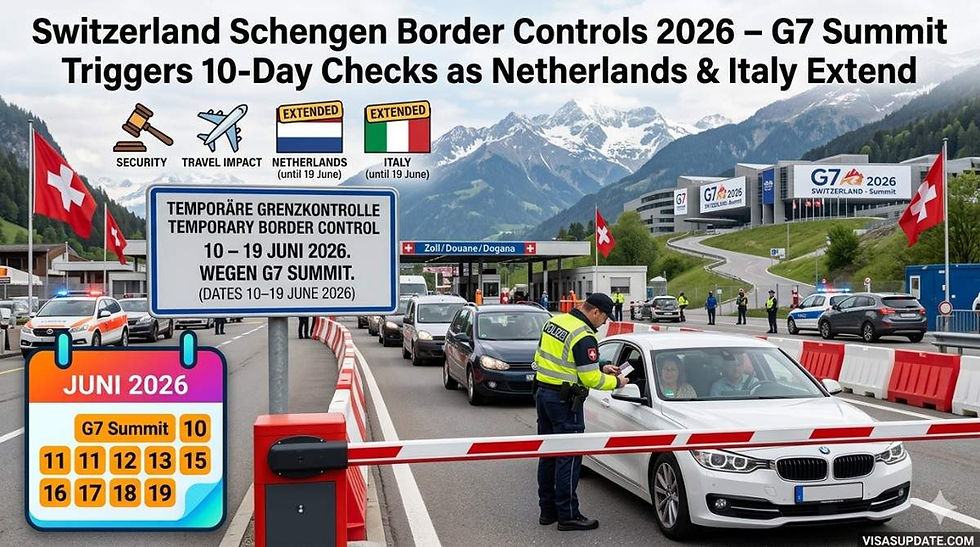
Bern, May 27, 2026 — Switzerland has announced it will temporarily reinstate border controls at its Schengen frontiers from 10 to 19 June 2026 to ensure security during the upcoming G7 Summit, joining a growing list of European countries extending internal border checks amid heightened security concerns.
The decision was confirmed by the Swiss Federal Customs Administration and aligns with similar extensions by the Netherlands and Italy, reflecting a broader trend across the Schengen Area where nations are increasingly using temporary border measures for major events and ongoing security risks.
Details of Switzerland’s Border Controls
Period: 10 June to 19 June 2026 (10 days)
Purpose: Protection during the G7 Summit hosted in Switzerland
Scope: Random checks at land borders with Germany, France, Italy, and Austria, as well as enhanced airport and rail screening
Impact: Minimal disruption expected for regular travellers, but longer wait times possible during peak hours
Swiss authorities emphasized that the controls will be proportionate and intelligence-led, focusing on preventing potential threats while maintaining the free movement of people and goods as much as possible.
Regional Context: Neighbours Extending Controls
The Swiss move comes as:
Italy has extended its border checks with Slovenia until December 2026, citing continued instability in the Western Balkans and broader international risks.
Netherlands has prolonged controls on its borders with Belgium and Germany, referencing hybrid threats, illegal migration, and terrorism concerns.
These extensions highlight a growing willingness among Schengen member states to temporarily suspend open borders when facing specific security or logistical challenges — a practice that has become more frequent since the 2015–2016 migration crisis and recent geopolitical tensions.
Reasons Behind the Trend
European governments cite multiple factors for maintaining or re-imposing controls:
Persistent irregular migration flows along the Balkan and Mediterranean routes
Heightened terrorism risks linked to international conflicts
Hybrid threats and disinformation campaigns
Major international events requiring enhanced security (such as the G7 Summit)
Switzerland, despite not being an EU member, participates fully in the Schengen Area and coordinates closely with neighbouring countries on border management.
Impact on Travellers and Businesses
Tourists and Commuters: Expect possible spot checks and longer queues at major crossings during the G7 period.
Business Travel: Companies with cross-border operations should plan extra time for logistics.
Air and Rail Travel: Enhanced screening at airports and international train stations is likely.
Travellers are advised to carry valid passports or ID cards and stay updated via official government travel advisories.
Broader Implications for Schengen
The repeated extensions of internal border controls raise questions about the long-term future of the Schengen system. While temporary measures are permitted under EU/Schengen rules, their increasing frequency has prompted calls for stronger external border management and faster asylum processing at the EU level.
Switzerland’s decision reinforces its commitment to security cooperation within the Schengen framework while hosting a high-profile international summit.
For the latest updates on Schengen border rules, Switzerland visa and residence permit requirements, and European immigration policy changes in 2026, visit: visasupdate.com/blog/categories/switzerland
Comments