


Portugal to Temporarily Suspend EES Biometric Registration at Airports to Prevent Queues

Updated: May 30
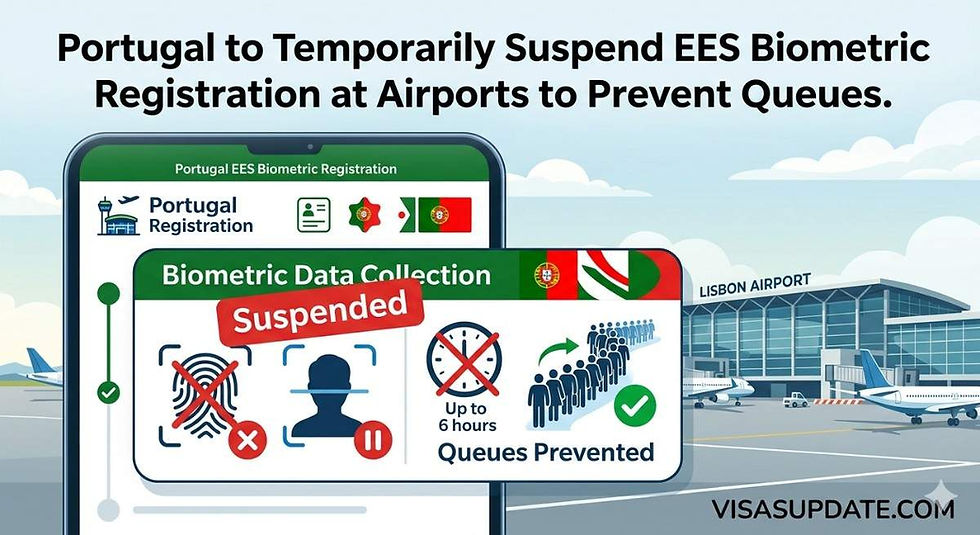
Lisbon, May 30, 2026 — Portugal has formally notified the European Commission that it will temporarily suspend the collection of biometric data under the new Entry/Exit System (EES) whenever necessary to avoid long queues at national airports.
The move, confirmed by the European Commission and reported by SIC Notícias, comes as a practical response to concerns over potential disruptions during peak travel periods following the full rollout of the EES.
What This Means for Travellers
The Entry/Exit System is designed to digitally record the entry and exit of non-EU nationals at Schengen borders using fingerprints and facial scans. However, during high-traffic periods, full biometric registration could cause significant delays at Portuguese airports.
Under the notification:
Portugal will be allowed to temporarily suspend biometric data collection when justified.
Suspensions can last up to 6 hours and may be renewed if needed.
Each suspension must specify the affected border crossing point (e.g., Lisbon Airport, Porto Airport, Faro Airport).
This flexibility aims to maintain smooth passenger flow while still complying with the core objectives of the EES.
Why Portugal Is Taking This Step
The EES is one of the largest digital border management projects in the world. While it promises long-term benefits such as improved security and automated border control, the initial implementation phase is expected to create bottlenecks at busy entry points.
Portuguese authorities are acting proactively to protect the country’s vital tourism industry, which relies heavily on efficient airport operations, especially during the busy summer season.
Broader European Context
Portugal is not alone in preparing contingency measures. Several other Schengen countries have also expressed concerns about operational readiness and potential queues. The European Commission has acknowledged that temporary suspensions may be necessary during the transition period, provided they are properly notified and proportionate.
All member states must inform Brussels in advance, detailing both the location and expected duration of any suspension.
What Travellers Should Expect
During suspensions: Simplified entry procedures (possibly stamp-based or visual checks) may be used instead of full biometric registration.
Normal operations: Full EES biometric collection (fingerprints + facial scan) will apply.
Peak periods: Higher chance of temporary suspensions, particularly at Lisbon (LIS), Porto (OPO), and Faro (FAO) airports.
Travelers should:
Verify the current EES status before leaving by consulting official airport or government resources.
Allocate additional time for border control during the initial months of EES implementation.
Make sure their passports are valid and in good condition.
Positive Outlook for Portugal’s Tourism Sector
Tourism stakeholders have welcomed the notification, viewing it as a pragmatic approach that balances security requirements with the need to maintain Portugal’s reputation as an efficient and welcoming destination.
As one of Europe’s most popular summer destinations, Portugal is determined to minimize any negative impact from the new border system while fully complying with EU regulations.
For the latest updates on EES implementation, Schengen border rules, Portugal visa and residence permit requirements, and European immigration policy changes in 2026, visit: visasupdate.com/blog/categories/portugal
Comments