


Italy's Meloni Announces School Face-Covering Ban and Cap on Foreign Students

Updated: 7 hours ago
ROME, September 21, 2026 — Italian Prime Minister Giorgia Meloni revealed on September 20 that her administration plans to introduce a proposal to prohibit burqas and niqabs in schools, limit the number of foreign students per classroom, and mandate Italian language classes for parents of foreign students who are experiencing significant integration challenges.
Speaking at the annual "Fenix" youth festival organised by her Brothers of Italy party in Rome, Meloni framed the measures as necessary for genuine integration and gender equality, drawing a standing ovation from the crowd .
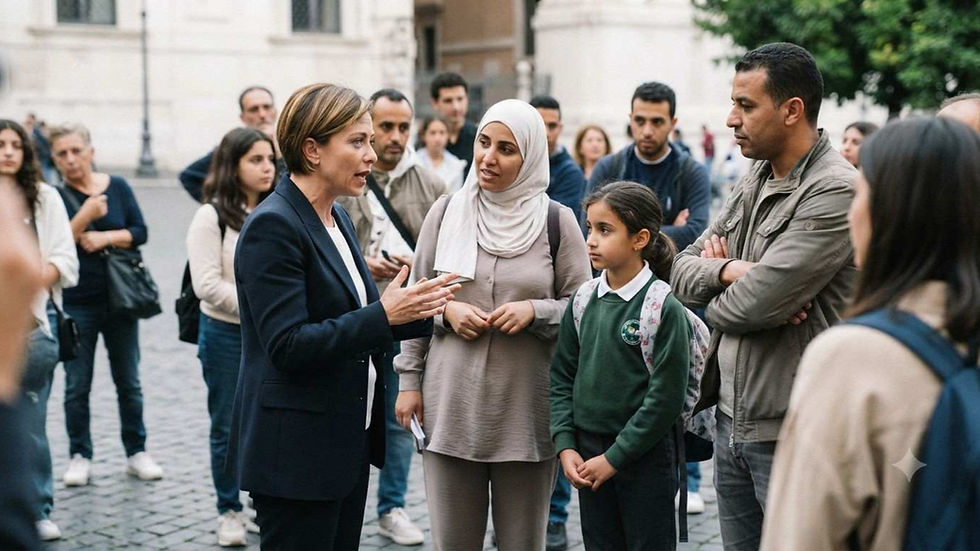
Key Provisions of the Proposed Measure
1. Face-Covering Ban
Students will be required to attend school with their faces uncovered. Meloni linked the measure directly to gender equality, stating:
"You must go to school with your face uncovered, and in Italy no one, in the name of a real or supposed tradition, can decide that a young woman must hide herself."
The ban specifically targets the burqa (full-body covering) and niqab (face veil leaving only the eyes visible). Notably, Meloni did not mention the hijab (headscarf) in her announcement .
2. Foreign Student Cap
A legal limit will be set for the maximum number of foreign students per class. Although Meloni did not specify the exact number, she clarified the reasoning:
"If there is only one child in a class who doesn't understand Italian, that child will likely learn the language and integrate quickly with support from classmates and teachers. However, if the number of children who don't understand the language becomes large — or even the majority — it ceases to be integration and becomes neglect."
Italy currently has non-binding guidelines suggesting a 30% reference limit for foreign students in classes. Education Minister Giuseppe Valditara recently called for clearer regulations because schools have not consistently adhered to the existing limit. The government now intends to establish the maximum through legislation.
3. Parental Language Requirement
Parents of international students experiencing significant challenges in integration will need to learn Italian.
"We believe that anyone who comes to Italy with the intention of creating a future here should learn our language, comprehend our culture, and adhere to our rules. This is the only genuine way to welcome them."
The Numbers Behind the Policy
According to Fondazione ISMU, a research institution:
Metric | Figure |
Students without Italian citizenship | 931,323 |
Share of total school population | 11.6% (nearly 12 in every 100 students) |
Total school population | Slightly more than 8 million |
Highest concentration | Primary school (13.7%) |
Lowest concentration | Upper secondary school (below 9%) |
Regional distribution | Over 65% in northern regions |
The data, based on the 2024/25 school year, shows that foreign students are disproportionately enrolled in technical institutes (40%) and vocational schools (28%), compared to native Italian students .
Legislative Process
Step | Status |
Announcement | September 20, 2026 |
Council of Ministers | Measure to be presented "soon" |
Parliamentary Approval | Needed within 60 days after government approval |
Status | Not yet law |
After receiving government approval, the measure must gain parliamentary approval within 60 days to become law.
Political Context
Migration and Integration Debate
Italy is among the European countries most exposed to migrant arrivals due to its central Mediterranean location, making migration a consistently hot-button issue . The integration of migrants, particularly those from Muslim-majority countries, remains contentious in Italian politics and society. Discussions about religious symbols, cultural integration, citizenship regulations, and immigration policy often divide public opinion.
Existing Legal Framework
Italy already has a law prohibiting the wearing of helmets or clothing that obstructs identification without justified reason. In 2008, Italy's highest administrative court ruled that face-covering veils could be worn in schools for religious reasons, but faces must be uncovered if identification is required .
Political Positioning
Meloni, whose political background is in the far-right, has always taken a firm stance on migration. Nonetheless, during her time as prime minister, she has politically transformed from a nationalist outsider to a mainstream figure among European Union politicians.
Quick Reference Summary
Aspect | Details |
Announcement Date | September 20, 2026 |
Venue | Fenix youth festival, Rome |
Face-Covering Ban | Burqas and niqabs prohibited in schools |
Foreign Student Cap | Maximum to be set by law; exact number unspecified |
Parental Requirement | Italian language lessons for parents of struggling students |
Current Foreign Student Share | 11.6% of school population |
Legislative Path | Council of Ministers → Parliament (60 days) |
Status | Proposed, not yet law |
Read Also
Official Resources
Resource | Link |
Italian Government | |
Ministry of Education and Merit | |
Fondazione ISMU |
For the latest immigration updates, visa policy changes, and 2026 developments worldwide, visit: visasupdate.com/blog/category/italy
VisasUpdate.com – The world's most trusted visa intelligence hub.Unlock 2026 immigration breakthroughs, digital nomad policies, and real-time fee alerts—all in one place.
Bookmark us now: visasupdate.com/news – Stay ahead.
Comments