


DHS Proposes $70,000 Fee for Initial OPT, $30,000 for Subsequent Periods

Updated: 32 minutes ago
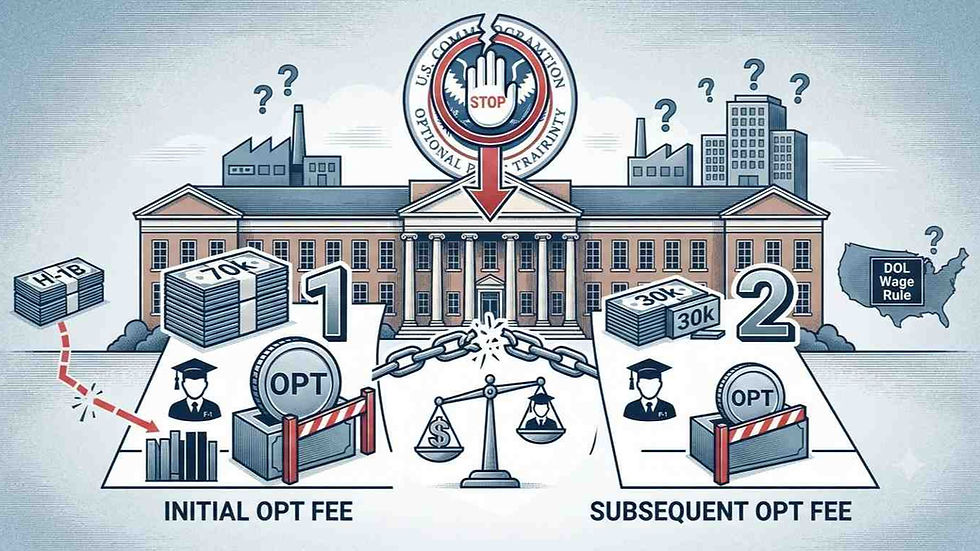
WASHINGTON, October 7, 2026 — The Department of Homeland Security has proposed a sweeping new fee structure for Optional Practical Training that would require universities to pay $70,000 before recommending an F-1 student for initial OPT, with subsequent recommendations costing $30,000 each.
The proposal, announced in an official DHS release on Tuesday, is scheduled for publication in the Federal Register on October 8, with a 30-day public comment period to follow. It would fundamentally reshape a program that has become the primary work-authorization pathway for international graduates in the United States.
What the Proposal Would Do
The fee structure targets the university recommendation step, not the student's application. Under current regulations, a school's Designated School Official must recommend an F-1 student for OPT in the SEVIS system before the student can apply to USCIS for an Employment Authorization Document.
The proposal would reverse that sequence's economics. Schools would have to pay the $70,000 fee before entering an OPT recommendation, and USCIS would refuse to grant work authorization if the fee hasn't been paid.
DHS acknowledges that universities could pass the cost to students, employers, or absorb it themselves. Schools could also seek refunds if USCIS ultimately denies the student's OPT application.
The Fee Isn't Tied to OPT Type
One detail stands out for students planning their post-graduation strategy: the fee amount depends on when the request is made, not what kind of OPT is requested.
The first OPT recommendation after the rule takes effect triggers the $70,000 fee — whether that's pre-completion OPT during study, standard post-completion OPT, or a STEM extension. Any subsequent recommendation for the same student costs $30,000, regardless of category.
This means a student who uses pre-completion OPT during their program would burn the "first" $70,000 trigger, and their post-graduation OPT would then cost $30,000.
Why DHS Is Proposing This
The agency frames the fees as an anti-fraud measure. DHS says the Student and Exchange Visitor Program has identified schools, employers, and students engaged in exploitation schemes, including "pay-to-stay" arrangements and problematic worksites.
A DHS spokesperson said the program "was never meant to be a back door into the American workforce, a subsidy for cheap labor, or a prize for those who game the system."
The proposal also signals a more drastic alternative: DHS states that without the fees, it cannot operate OPT consistent with its fraud-prevention focus and may shut down the program entirely.
The Broader H-1B Fee Context
The OPT proposal is the latest in a series of fee escalations for employment-based immigration. It follows two high-profile H-1B measures.
The $100,000 H-1B fee — imposed by presidential proclamation in September 2025 and extended through September 2027 — is currently not enforceable. Two federal courts have vacated the policies implementing it, finding that agencies skipped required notice-and-comment rulemaking. On September 30, 2026, a second federal judge once more halted enforcement.
A separate $103,265 H-1B cap-subject petition fee was proposed in August 2026 and remains in the regulatory pipeline. DHS estimates it would generate around $8.8 billion each year from 85,000 cap-subject petitions. This proposal is also anticipated to encounter legal challenges.
Adding to the pressure on employers, the Department of Labor has proposed raising prevailing wages for H-1B, E-3, H-1B1, and PERM applications, which would further increase the cost of sponsoring foreign professionals.
DHS explicitly cites the OPT fees as a measure to prevent employers from circumventing the H-1B fees by keeping workers on OPT instead.
What Happens Next
The proposed rule is not in effect. Universities and students face no new fees today. DHS must review public comments, potentially revise the rule, and publish a final version with an implementation date.
If the rule is finalized, legal challenges are broadly expected.Given the pattern with the H-1B fees — where courts found procedural violations — the OPT proposal faces similar administrative-law risk.
For now, current OPT rules apply: students pay approximately $470–$520 in USCIS filing fees for the EAD, and schools charge no fee for the recommendation itself.
Quick Reference Summary
Item | Detail |
Proposed Initial OPT Fee | $70,000 |
Proposed Subsequent OPT Fee | $30,000 |
Who Pays | SEVP-certified schools (may pass to students/employers) |
Fee Trigger | Initial OPT suggestion following rule implementation |
Fee Not Tied To | OPT type (pre-completion, post-completion, STEM) |
Public Comment Period | 30 days from October 8, 2026 publication |
Current Status | Proposed; not in effect |
H-1B $100K Fee Status | Blocked by courts; unenforceable |
H-1B $103,265 Fee | Proposed; under review |
DOL Wage Rule | Proposed; pending |
Read Also
For the latest immigration updates, visa policy changes, and 2026 developments worldwide, visit: visasupdate.com/blog/category/usa
VisasUpdate.com – The world's most trusted visa intelligence hub.Unlock 2026 immigration breakthroughs, digital nomad policies, and real-time fee alerts—all in one place.
Bookmark us now: visasupdate.com/news – Stay ahead.
Comments