


$25 Minimum Wage by 2031: Sen. Chris Murphy’s Bold “Living Wage for All Act” Could Transform America – But Is It Enough?
- Xavi

- Jun 26
- 3 min read
Updated: Jun 26
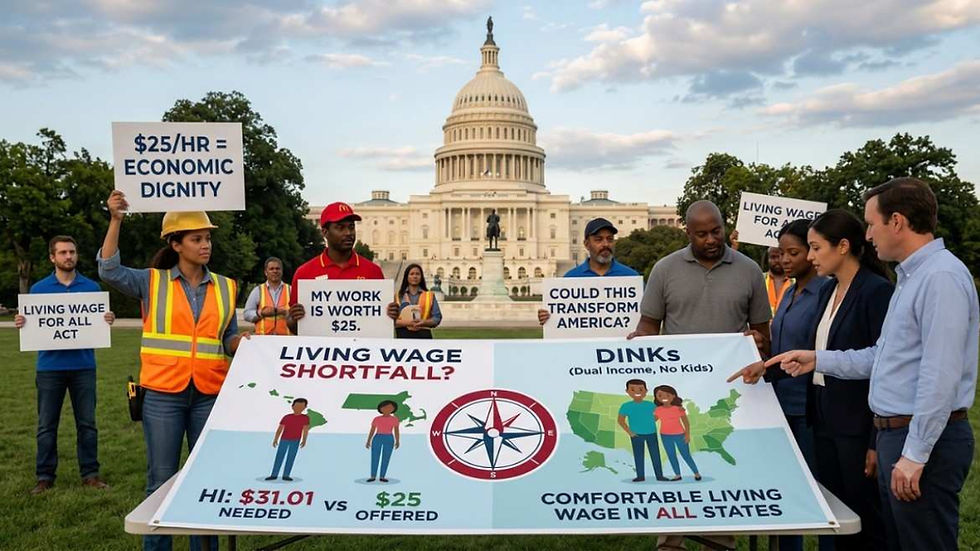
Washington D.C., 26 June 2026 — In a move that could reshape the American workplace, Senator Chris Murphy (D-Connecticut) is set to introduce the Living Wage for All Act, a sweeping proposal that would gradually raise the federal minimum wage to $25 per hour by 2031 for large employers. If passed, it would mark the most dramatic increase in the federal minimum wage since it was last raised to $7.25 in 2009 — and spark fierce debate over whether it finally delivers economic dignity or risks unintended consequences for small businesses and inflation.
While ambitious, the bill highlights a growing reality: in many parts of the country, even $15 an hour — the target of previous proposals — falls short of a true living wage.
What the Living Wage for All Act Suggests
Large Employers (typically 500+ employees): Raise to $25/hour by 2031, with incremental increases starting at $12/hour in the first year.
Smaller Employers: Extended timeline until 2038 to comply.
Focus: Address the rising cost of housing, healthcare, childcare, and daily necessities that have outpaced wage growth for decades.
Supporters argue this is not just about fairness — it’s about economic survival in a country where the cost of living has skyrocketed while the federal minimum wage has remained frozen for 17 years.
MIT Living Wage Calculator 2026: How $25 Stacks Up Across America
Using the latest data from MIT’s Living Wage Calculator, which factors in food, housing, transportation, healthcare, and childcare, a $25 hourly wage tells a very different story depending on family situation and location.
For a Single Working Adult (No Children):
$25/hour is enough to live self-sufficiently in 36 states.
Not enough in 14 states and Washington D.C., led by:
Hawaii: $31.01/hour needed
Massachusetts: $30+
California: $30+
Lowest requirement: West Virginia at $19.53/hour
For DINKs (Dual Income, No Kids):
Two adults earning $25/hour each would exceed a living wage in every state.
Even in the most expensive state (Hawaii), the combined income comfortably covers basic needs.
For a Family of Four (Two Working Adults):
$25/hour per adult is sufficient in only 11 states — and only barely in some.
Top affordable states: Kansas ($24.99), Iowa, Texas, West Virginia, South Dakota, Alabama, Louisiana, Tennessee, Arkansas, Kentucky, and Mississippi.
In Massachusetts, two working adults would each need nearly $40/hour to be self-sufficient.
These figures underscore a harsh truth: no current state minimum wage meets a true living wage for a single adult, let alone a family — making the push for $25 nationally a response to deep structural gaps.
Political Context and Reactions
Senator Murphy’s bill builds on years of stalled attempts to raise the federal minimum wage. While progressive Democrats hail it as long-overdue economic justice, critics from the business community and conservative circles warn of:
Job losses in low-margin industries
Higher prices for consumers
Accelerated automation and offshoring
Disproportionate impact on small businesses and rural economies
The legislation faces an uphill battle in a divided Congress, but its introduction adds fuel to the national conversation about wages, inequality, and the cost of living crisis.
Broader Implications for American Workers
If passed, the bill would directly affect millions of workers in retail, hospitality, food service, and care industries. Proponents argue it would reduce reliance on government assistance programs, boost consumer spending, and improve health outcomes by reducing financial stress. Critics counter that sudden wage hikes could lead to reduced hiring, especially for young and entry-level workers.
What This Means for You
Workers: A potential path to higher earnings, but timing and implementation matter.
Employers: Need to plan for phased increases, especially larger companies.
Consumers: Possible price adjustments in everyday goods and services.
Economists: Divided on the net effect, with studies showing mixed results from past minimum wage increases.
The Living Wage for All Act arrives at a moment when many Americans are struggling with housing affordability, healthcare costs, and stagnant wages. Whether it becomes law or serves as a starting point for negotiation, it forces a national reckoning with the question: What does it really cost to live in America in 2026?
For the latest US minimum wage news, Living Wage Act updates, MIT Living Wage Calculator analysis, and 2026 labour policy developments, visit: visasupdate.com/blog/categories/usa
Comments