


Breaking: U.S. Expands Visa Bond Program to 50 Countries Starting April 2, 2026 – $15,000 Security Deposit Now Required for B-1/B-2 Visas from High-Overstay Nations

Updated: Mar 19
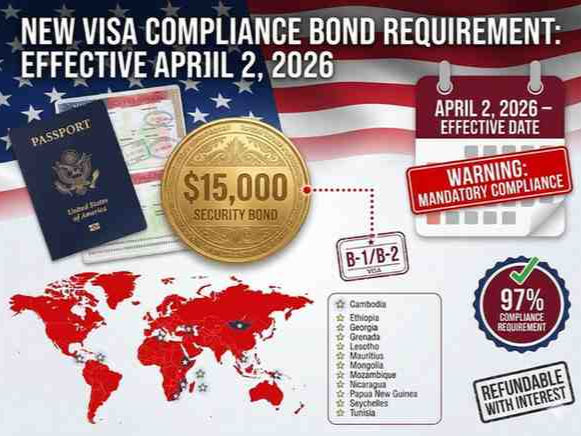
The U.S. Department of State has confirmed one of the most significant changes to nonimmigrant visa policy in recent years. Effective April 2, 2026, nationals of 50 countries will be required to post a $15,000 visa bond before receiving a B-1 (business) or B-2 (tourism) visa to enter the United States.
The bond is fully refundable — with interest — provided the traveler departs the U.S. before the authorized stay expires and does not violate visa terms. If the traveler overstays or otherwise violates status, the bond is forfeited to the U.S. government.
This expansion adds 12 new countries to the existing list of 38 nations already subject to the visa bond requirement, bringing the total to 50.
The 12 New Countries Added April 2, 2026
Cambodia Ethiopia Georgia Grenada Lesotho Mauritius Mongolia Mozambique Nicaragua Papua New Guinea Seychelles Tunisia
Full List of 50 Countries Now Requiring $15,000 Visa Bond for B-1/B-2 Visas
Algeria, Angola, Antigua and Barbuda, Bangladesh, Benin, Bhutan, Botswana, Burundi, Cabo Verde, Central African Republic, Cambodia, Cote d’Ivoire, Cuba, Djibouti, Dominica, Ethiopia, Fiji, Gabon, The Gambia, Georgia, Grenada, Guinea, Guinea-Bissau, Kyrgyzstan, Lesotho, Malawi, Mauritius, Mongolia, Mozambique, Namibia, Nepal, Nicaragua, Nigeria, Papua New Guinea, Sao Tome and Principe, Senegal, Seychelles, Tajikistan, Tanzania, Togo, Tonga, Tunisia, Turkmenistan, Tuvalu, Uganda, Vanuatu, Venezuela, Zambia, Zimbabwe.
Visa Bond Program: Why It Exists, How It Works & Latest Reported Results (2026 Update)
The Department of State launched the visa bond pilot in late 2024 to combat visa overstays, which cost U.S. taxpayers an estimated $18,000 per removal on average (including detention, transportation, and administrative costs).
According to the latest State Department figures released in March 2026:
Nearly 1,000 bonded visas issued so far
97% of bonded travelers returned home on time
In contrast, during the last full year of the previous administration, more than 44,000 visitors from the current 50 visa-bond countries overstayed their authorized period
The Department estimates the program is already saving U.S. taxpayers hundreds of millions of dollars annually by reducing the number of individuals who remain unlawfully after their B-1/B-2 stay expires.
How the Visa Bond Works in Practice (2026 Rules)
Amount: $15,000 per applicant (non-refundable processing/admin fee may apply separately)
Refund process: Automatic refund (plus interest) after departure compliance is verified through exit records
Forfeiture: Bond is forfeited if traveler overstays, works without authorization, or otherwise violates B-1/B-2 terms
Who pays: Applicant posts bond before visa issuance (exact payment mechanism still being finalized for consular posts)
Appeals/waivers: No automatic waivers announced; case-by-case humanitarian exceptions possible but rare
Impact on Travelers & Travel Agencies
Travelers from the 50 listed countries planning business trips, tourism, medical visits, or family reunions must now:
Budget an additional $15,000 upfront (refundable if compliant)
Apply earlier — consular processing times may increase due to bond verification
Provide stronger evidence of intent to return home (ties, employment, property, etc.)
Travel agencies and visa consultants report growing inquiries from affected nationals, especially from newly added countries such as Cambodia, Ethiopia, Georgia, Mongolia, and Tunisia.
Frequently Asked Questions (FAQ) – U.S. Visa Bond Program 2026
Which visa types require the $15,000 bond?
Only B-1 (business) and B-2 (tourism/medical/family visit) visas. Other categories (student, work, fiancé, etc.) are not affected.
Is the bond refund guaranteed if I leave on time?
Yes — the State Department states the bond is refunded (with interest) after CBP confirms timely departure via exit records.
Can the bond be waived?
No blanket waivers exist. Limited case-by-case humanitarian or diplomatic exceptions may be considered, but approval is rare.
Does the bond apply to children and dependents?
Yes — each applicant, including minors, must post a separate $15,000 bond.
How does this compare to previous visa policies?
This is the largest expansion of a financial security requirement for B visas in modern U.S. immigration history.
Official source for updates travel.state.gov → Visa Bond Program section (Always check directly — third-party sites may contain outdated or inaccurate information)
Planning travel to the United States?
Explore our complete guides on B-1/B-2 visas, ESTA requirements, visa interview tips, and overstay consequences: USA Visa & Immigration Updates
The April 2, 2026 expansion of the visa bond program marks a major tightening of U.S. tourist and business visitor screening for nationals of 50 countries. Travelers from affected nations should prepare for the $15,000 upfront deposit and apply significantly earlier than in previous years.
Last updated: March 2026 | Based on official U.S. Department of State announcements and visa policy documents.
Comments