


The Great Shift: Navigating Sweden’s Restrictive New Citizenship Law (2026–2028)

Updated: May 1
For decades, Sweden was known for having some of the most accessible citizenship pathways in the European Union. However, the legislative package approved by the Swedish government marks the end of that era. Driven by a political shift toward "integration through requirement," these new rules transition citizenship from a relatively simple administrative milestone into a rigorous merit-based achievement.
I. The "Decision-Date" Trap: Why Your Filing Date Might Not Matter
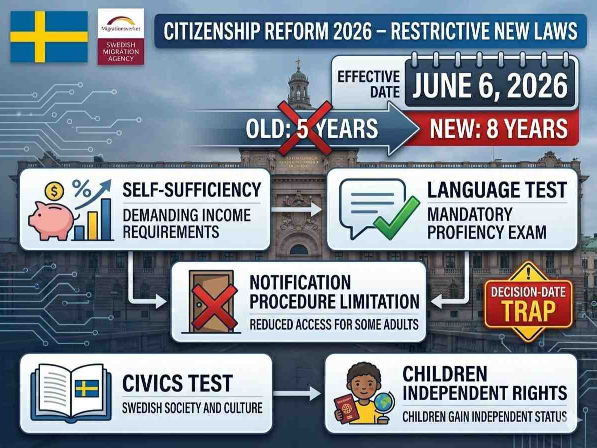
The most critical aspect of this reform is a legal principle that many applicants find distressing: Applications are assessed under the law in force at the time of the decision, not the time of submission.
This creates a "ticking clock" scenario for thousands of residents. If you applied in 2024 or 2025 based on the current 5-year residency rule, but the Swedish Migration Board (Migrationsverket) does not finalize your case before June 6, 2026, your application will instantly become invalid if you have not yet reached the new 8-year threshold.
The Impact of Processing Backlogs
Currently, processing times for Swedish citizenship can range from several months to nearly three years. Applicants caught in this backlog face a "limbo" period. If June 6, 2026, passes while your file is on a desk, you may be required to remain in Sweden for an additional three years before a positive decision can legally be rendered.
II. Key Pillars of the 2026 Reform
The government has identified five core pillars that form the foundation of this restrictive package:
1. Residency: The Eight-Year Standard
Starting June 6, 2026, the general residency requirement jumps from five years to eight years.
The Logic: The government argues that five years is insufficient to prove deep-rooted integration or to assess a person’s long-term commitment to Swedish values.
The Exceptions: While the pool of eligible applicants will shrink drastically, Nordic nationals (Danes, Finns, Norwegians, and Icelanders) will continue to benefit from shorter pathways, maintaining the regional cohesion of the Nordic Council.
2. The Self-Sufficiency Requirement
For the first time in modern history, Sweden will impose a strict financial threshold for citizenship. Applicants must prove they can support themselves without state intervention.
The Metric: Self-sufficiency is tied to three income base amounts per year.
Social Assistance: Dependence on social welfare (försörjningsstöd) will now act as a primary disqualifier. This shift ensures that citizenship is granted to those who are active contributors to the Swedish economy.
3. Knowledge of Language and Society (Civics)
Perhaps the most discussed change is the introduction of mandatory testing. This will be rolled out in a "staged commencement" to allow the infrastructure for nationwide testing to be built:
Phase 1 (Oct 1, 2027): Mandatory reading and listening comprehension tests in Swedish at a functional level.
Phase 2 (TBD): Comprehensive tests covering speaking, writing, and a "Civics Test" regarding Swedish law, history, and social norms.
Note: If your application is delayed past 2027 due to the residency hike, you will likely be forced to pass these tests even if they didn't exist when you first applied.
4. Limitation of the "Notification Procedure"
The "Notification Procedure" was a fast-track, simplified pathway for certain groups (like young adults or stateless persons). Starting June 2026, this door will largely swing shut. Most foreign nationals will be funneled into the standard application process, subjecting them to the full weight of the 8-year residency and self-sufficiency rules.
5. New Independent Rights for Children
In a rare move toward modernization within a restrictive package, children will now be able to acquire citizenship independently. Previously, a child's status was often tethered to their parents' application (derivative citizenship). Starting June 2026, guardians can submit standalone applications for children, ensuring their legal security is not compromised by a parent's complicated application history.
III. Comparing the Old vs. New Systems
Requirement | Pre-June 2026 | Post-June 2026 |
Residency Period | 5 Years | 8 Years |
Language Skills | None required | Mandatory Testing (Staged) |
Financial Status | Not assessed | 3 Income Base Amounts/Year |
Civics Knowledge | None required | Mandatory Test (Post-2027) |
Processing Rule | Date of Application | Date of Decision |
Export to Sheets
IV. Strategic Recommendations for Current Residents
If you are a foreign national currently residing in Sweden, your strategy depends entirely on your "Residency Anniversary."
If you hit 5 years before late 2024: File immediately. You have a reasonable chance of receiving a decision before the June 2026 "cliff."
If you hit 5 years in late 2025: Prepare for the possibility of a rejection or a "hold" on your case. If the decision isn't made by June 6, 2026, you will need to prove 8 years of residency.
Documentation: Start gathering proof of income and self-sufficiency now. Even if you aren't required to show it today, you likely will be by the time your case is reviewed.
V. Looking Ahead: The "Meaning" of Citizenship
The Swedish government’s background for these changes is clear: Citizenship should be harder to obtain so that it is more meaningful. By aligning with the stricter policies seen in Denmark and Norway, Sweden is signaling a transition from a "country of arrival" to a "society of integration."
As June 2026 approaches, the Migration Agency is expected to release further interim guidelines on how they will handle the "transition generation"—those caught between the five-year and eight-year rules. For now, the message to applicants is one of caution: The goalposts are moving, and your arrival in Sweden is just the beginning of a much longer marathon.
Comments