


Japan Tightens Foreign Driver’s License Conversions and Business Manager Visa Rules

Updated: May 9
Tokyo, May 9, 2026 — Japan’s government is pushing ahead with stricter immigration controls, with new data showing dramatic effects on foreign driver’s license conversions and entrepreneur visa applications. The changes, part of a broader policy to ensure orderly coexistence with foreign nationals, are already reshaping access for residents and small business owners.
According to a progress report released by the Cabinet Secretariat’s Office for a Society of Well-Ordered and Harmonious Coexistence with Foreign Nationals, several measures introduced in late 2025 have significantly reduced approvals in targeted areas.
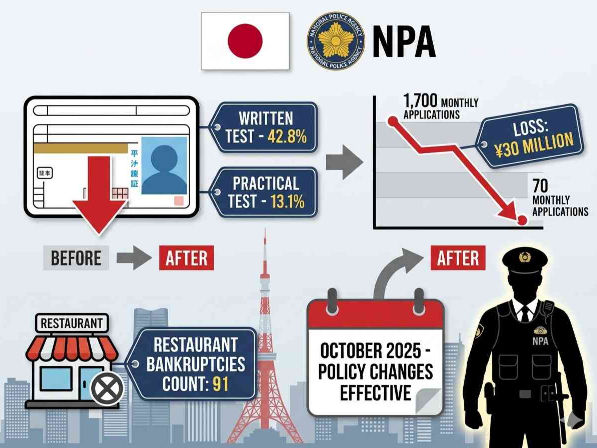
Sharp Drop in Foreign Driver’s License Conversions
In October 2025, the National Police Agency tightened procedures for converting foreign driver’s licenses to Japanese ones (known as gaimen kirikae). The reforms closed loopholes that previously allowed short-term visitors and those without proper resident records to use hotel addresses for applications.
Results were immediate and striking. In the three months following the changes, the written test pass rate plummeted to 42.8%, a drop of nearly 50 percentage points from 92.5% in 2024. The practical driving test pass rate also fell from 30.4% to 13.1%.
The agency has since emphasized strict enforcement, barring applicants on tourist visas or without a valid resident record from converting their licenses. Authorities are also studying international licensing systems and analyzing traffic accident data involving foreign drivers.
Business Manager Visa Applications Collapse
Applications for the Business Manager status of residence — used by foreign entrepreneurs to establish and run companies in Japan — have also plummeted.
In October 2025, the government raised the minimum capital requirement from ¥5 million to ¥30 million (approximately $192,000) to prevent the creation of shell companies with no genuine business activity.
Monthly applications, which had averaged around 1,700 between May and mid-October 2025, fell to roughly 70 per month in the following period — a 96% decline.
The category had faced criticism for being exploited as an easy entry route, particularly for setting up small lodging or restaurant businesses.
Impact on Small Businesses
A recent survey by Tokyo Shoko Research found that about 45% of companies run by foreign nationals expect negative effects from the tighter rules, while another 5.3% are considering closing their operations.
The impact is particularly visible in the restaurant sector. Bankruptcies among “other specialty restaurants” — a category that includes many small Nepalese and Indian-run curry shops often called “Indo-Nepali” restaurants — reached 91 in fiscal 2025, the highest number in 30 years. Many of these businesses were already struggling with rising costs and labor shortages.
Broader Immigration Enforcement Efforts
These measures form part of Japan’s wider strategy to manage foreign residency more effectively. Key initiatives include:
The Zero Illegal Foreign Residents Plan launched by the Immigration Services Agency in May 2025, which has already reduced the backlog of pending refugee applications.
Strengthened crackdowns on illegal employment, with 1,837 arrests in 2025 — a 30% increase from the previous year.
The expected passage of the JESTA (Japan Electronic System for Travel Authorization) bill, which will introduce pre-travel screening for visitors from visa-exempt countries. Implementation is targeted for fiscal 2028.
Minister Kimi Onoda, who oversees policies for coexistence with foreign nationals, has indicated that the government will continue reviewing the rules and their implementation to balance control with fairness.
Outlook
Although the stricter regulations are designed to eliminate loopholes and guarantee a true economic contribution, there are still worries about the impact on legitimate small businesses and the possibility of discouraging certain types of foreign talent and investors.
Japanese authorities have indicated they will closely observe the situation and make necessary adjustments to uphold public confidence in the immigration system.
For the latest updates, detailed guides, and analysis of Japanese visas, residence permits, and immigration policy changes, visit: visasupdate.com/blog/categories/japan
Comments