


Italy’s Worker Shortage Crisis 2026: A Demographic Time Bomb Threatening Economic Future

Updated: May 16
By visasupdate.com Published: May 16, 2026
Italy is facing one of the most severe labor shortages in Europe. Despite record-low unemployment in some metrics, businesses across key sectors struggle to find workers. This crisis stems from a toxic mix of an aging population, plummeting birth rates, youth emigration (brain drain), and changing workforce expectations. In response, the Italian government under Prime Minister Giorgia Meloni has approved one of the largest legal migration expansions in decades.
This in-depth analysis explores the causes, impacts, government responses, and future outlook of Italy’s worker shortage crisis.
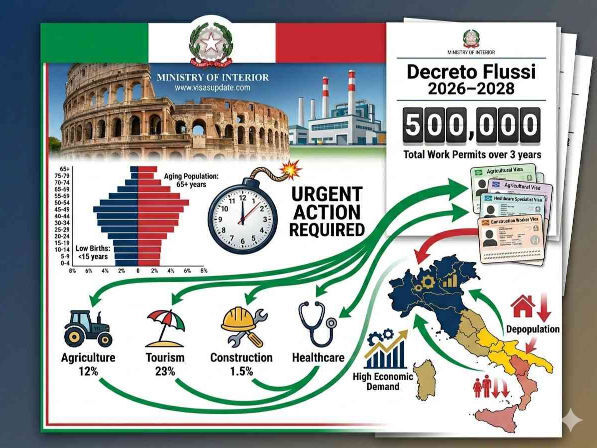
1. The Scale of Italy’s Demographic Crisis
Italy has one of the oldest populations in the world, with a median age of around 48 years. The country’s fertility rate hit a record low of 1.14 children per woman in 2025, far below the replacement level of 2.1.
In 2025, Italy recorded only 355,000 births — the lowest since unification in 1861 — while deaths stood at approximately 652,000. This natural population decline has been ongoing for over a decade. Without immigration, Italy’s population would be shrinking rapidly. Thanks to net migration of around 296,000 in 2025, the resident population stabilized at 58.94 million after 12 years of contraction.
Projections are sobering:
By 2050, the working-age population could shrink by more than 7 million.
By 2070, Italy’s population may fall to as low as 47.7 million.
This demographic winter creates massive pressure on the labor market, pension system, healthcare, and overall economic growth.
2. Labor Shortages Hit Key Sectors Hard
One in three Italian companies plans to hire non-EU workers by 2026 due to the inability to find local staff, according to a Unioncamere-Tagliacarne survey.
Most affected sectors include:
Agriculture & Food Processing: Chronic seasonal shortages, especially in fruit and vegetable harvesting in regions like Puglia, Sicily, and Veneto. Many farms face reduced production or spoiled harvests.
Tourism & Hospitality: Hotels, restaurants, and resorts along the Amalfi Coast, Tuscany, and major cities struggle every peak season. Post-pandemic recovery amplified the gap.
Construction & Infrastructure: Massive public and private projects under the National Recovery and Resilience Plan (PNRR) face delays due to skilled trades shortages (masons, electricians, welders).
Healthcare & Social Care: Aging population drives demand for nurses, caregivers (badanti), and medical technicians. Many elderly Italians rely on foreign caregivers.
Manufacturing & Logistics: Especially in the industrial North (Lombardy, Veneto, Emilia-Romagna), factories report difficulties filling technical and operator roles.
Personal Services & Domestic Care: Growing demand as the population ages.
Employers cite not just quantity issues but also quality: many young Italians prefer different careers or emigrate for higher salaries. A young graduate in Germany earns on average 80% more than in Italy.
3. Brain Drain and Youth Emigration
Italy loses thousands of highly educated young people every year. Better salaries, career opportunities, and quality of life abroad pull talent to countries like Germany, Switzerland, the UK, and North America.
This “brain drain” worsens the skills mismatch. While youth unemployment remains relatively high in southern Italy, many graduates refuse low-paid or physically demanding jobs in the North or in seasonal sectors.
4. Government Response: Historic Expansion of Legal Migration
In a pragmatic shift, Italy’s right-wing government has dramatically increased legal migration channels to protect economic growth while cracking down on irregular entries.
Nearly 500,000 new work permits for non-EU nationals over three years.
164,850 permits in 2026 alone.
Significant portion for seasonal work in agriculture and tourism (around 267,000 over three years).
Remaining for non-seasonal work in construction, healthcare, manufacturing, etc.
This is Italy’s largest migration quota expansion in decades. The government frames it as a controlled, needs-based approach aligned with business demands and social partners.
Other measures:
Streamlined skills recognition.
Increased focus on bilateral labor agreements (e.g., with countries in Africa, Asia, and the Balkans).
Efforts to integrate asylum seekers and regularize certain undocumented workers in shortage occupations.
Investment in vocational training and apprenticeships to upskill local youth.
5. Challenges and Criticisms
While the quota increase is welcomed by businesses, challenges remain:
Integration: Ensuring newcomers learn Italian, understand local culture, and find long-term housing.
Exploitation Risks: Seasonal and care sectors have histories of poor working conditions and illegal intermediation (caporalato).
Public Opinion: Balancing labor needs with concerns over social cohesion and irregular migration.
Administrative Bottlenecks: The traditional “Click Day” system for applications often leads to website crashes and unfair competition.
Regional Disparities: Shortages are acute in the productive North, while southern regions suffer from higher unemployment and depopulation.
6. Opportunities for Foreign Workers and Employers (2026 Guide)
High-demand profiles in 2026:
Seasonal agricultural workers
Caregivers and nurses
Construction tradespeople
Chefs and hospitality staff
Truck drivers and logistics personnel
Digital and tech specialists (under skilled worker streams)
Visa Pathways:
Seasonal work visas (Decreto Flussi)
Non-seasonal work permits
Intra-company transfers
Highly skilled worker routes
Family reunification options
Employers can benefit from multi-year planning visibility under the new three-year framework.
7. Long-Term Solutions Beyond Immigration
Experts agree that migration alone cannot solve the crisis. Italy must:
Boost birth rates through family-friendly policies (childcare, housing support, parental leave).
Boost the participation of women in the workforce (currently one of the lowest rates in Europe).
Improve education and vocational training.
Raise productivity through technology, AI, and automation.
Encourage return migration of Italians abroad.
Reform pension and retirement age policies.
Conclusion: A Defining Decade for Italy
Italy’s worker shortage crisis is not a temporary post-pandemic hiccup — it is a structural challenge rooted in decades of demographic trends. The bold expansion of legal migration under the 2026–2028 Flow Decree shows recognition of economic realities, but success will depend on effective implementation, integration, and complementary domestic reforms.
For businesses, the message is clear: plan ahead, engage with the new quota system, and invest in workforce development. For foreign workers with in-demand skills, Italy offers growing opportunities in one of Europe’s most vibrant economies and attractive lifestyles.
The coming years will determine whether Italy can turn its demographic challenge into a managed transition or whether labor shortages will become a permanent drag on growth and prosperity
For the latest guides, visa updates, and sector-specific opportunities in Italy, visit: visasupdate.com/blog/categories/italy
If you're looking for private fertility treatment in London, I wholeheartedly recommend this clinic. The consultant-led approach, personalised treatment plans, and exceptional level of patient care set them apart from other clinics we considered. Every member of the team was kind, supportive, and dedicated to helping us throughout our fertility journey, making the entire experience as comfortable and reassuring as possible. https://www.lunafertility.co.uk