


Hungary’s New Government Announces Strict Limits on Non-EU Guest Workers and Immigration Review

Updated: May 11
Budapest, May 11, 2026 — Following Péter Magyar’s landslide victory in the April 2026 parliamentary elections, Hungary’s incoming Tisza Party government is moving quickly to reshape the country’s immigration framework. While maintaining a hardline stance on illegal migration, the new administration has signaled a significant tightening of legal pathways for low-skilled non-EU workers.
Prime Minister-elect Péter Magyar has pledged to prioritize Hungarian workers and returnees from the diaspora, announcing a temporary suspension of new non-EU guest worker permits starting from June 1, 2026.
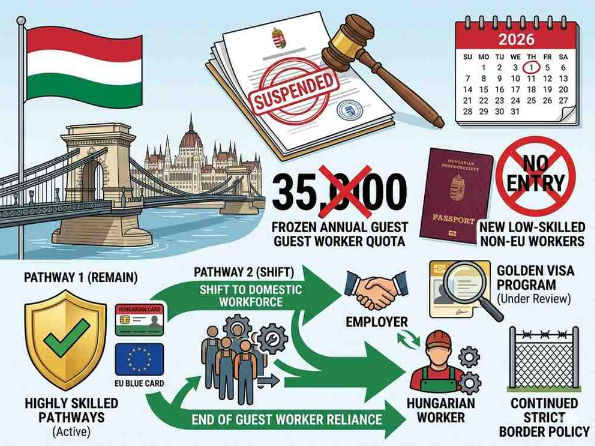
Key Elements of the New Immigration Approach
Suspension of New Non-EU Guest Worker Permits: From June 2026, no new residence permits for low-skilled or guest workers from outside the European Union will be issued until further notice. The previous government had maintained an annual quota of 35,000 guest workers for both 2025 and 2026. This cap is now effectively frozen for new arrivals.
Focus on Existing Permits: Current guest workers may see tighter oversight, though existing valid permits are expected to be honored until expiry. Renewals could face stricter scrutiny.
Continued Strict Border Policy: The government will maintain and strengthen the southern border fence, reject the EU Migration and Asylum Pact, and refuse mandatory relocation quotas. Magyar has emphasized that Hungary will not become a destination for illegal migration.
Review of Golden Visa / Guest Investor Program: The residency-by-investment scheme (offering 10-year residence permits) is likely to face review due to past concerns over transparency, security checks, and EU relations.
Preference for Highly Skilled and Domestic Talent: Pathways such as the Hungarian Card (for highly qualified professionals), EU Blue Card, and other skilled worker routes are expected to remain available, with a stronger emphasis on addressing specific labor shortages through local and returning Hungarian workers.
Context and Rationale
The new government argues that the rapid expansion of guest worker programs under the previous administration depressed wages in certain sectors and reduced incentives for Hungarians working abroad to return. Sectors such as manufacturing, construction, logistics, and agriculture have relied heavily on workers from Asia (e.g., Vietnam, Philippines, India) in recent years.
Péter Magyar and senior Tisza officials have stressed that economic growth should first benefit Hungarian citizens and that immigration policy must serve national interests more directly.
Implications for Different Groups
Current Guest Workers: Permits already issued are likely to remain valid, but future renewals and family reunification may become more difficult.
Employers: Companies dependent on foreign labor will need to adjust recruitment strategies, invest in automation, or improve wages and conditions to attract Hungarian workers.
Highly Skilled Professionals: Opportunities through the Hungarian Card, EU Blue Card, researchers, and specialists are expected to continue or even expand.
Investors: Those interested in the Guest Investor (Golden Visa) program are advised to monitor developments closely and consider applying before potential changes are introduced.
What’s Next?
The new government is scheduled to take office in late May 2026. Further details on implementation, transitional arrangements, and any exceptions (e.g., for specific strategic sectors or nationalities) are expected in the coming weeks.Authorities have stated they will focus on engaging in dialogue with businesses and stakeholders throughout the transition.
This shift represents a notable policy evolution — maintaining strong controls on migration while attempting to rebalance the labor market in favor of domestic workers.
For the latest updates, detailed guides, and analysis of Hungarian residence permits, work visas, and investment programs, visit: visasupdate.com/blog/categories/hungary
Hope they would recruit more non eu employees to solve labour shortage